


Programmatic SEO is a scalable approach to creating search-focused webpages using templates, structured data, and automation. Instead of manually writing every page, a programmatic SEO system uses repeatable page templates and data inputs to generate many pages that target long-tail keywords, product variations, locations, categories, or other repeatable search patterns.
When done well, programmatic SEO can help websites cover large groups of related search queries more efficiently. It is commonly used by ecommerce sites, marketplaces, directories, travel websites, SaaS companies, and businesses with large, structured datasets. But this strategy is not without risk. Marketers need to avoid keyword stuffing, and each page still needs a clear purpose, useful information, distinct search intent, and a strong user experience. Here are the most important things to know if you’re considering adopting programmatic SEO as part of your digital marketing strategy.

What is Programmatic SEO?
Programmatic SEO is the process of automatically or semi-automatically creating keyword-targeted pages through templates, data sources, and publishing workflows. These pages are usually built from structured information such as product feeds, location databases, listings, integrations, reviews, pricing data, service areas, or other repeatable content elements.
For example, a travel website may generate destination pages for many cities, while an ecommerce store may create product, category, or comparison pages based on product data. A marketplace may create listing pages by category, location, or feature set.
The strategy works best when the website has enough structured data to create pages that are genuinely useful. If the data is shallow or the template is too repetitive, programmatic SEO can create thin, duplicate, or low-value pages.
Scaling with Syntax vs. Generative AI Content
Programmatic SEO is primarily built around structured data, page templates, and syntax-based content generation. A programmatic SEO system uses a repeatable template with dynamic fields that pull from a website’s data layer, database, spreadsheet, CMS, API, or product feed.
For example, a page template may include fixed phrases before and after dynamic inputs such as {city}, {service}, {product_type}, {brand}, {price_range}, {feature}, or {use_case}. These data-layer elements create page-specific titles, headings, body copy, metadata, image alt text, internal links, and calls to action based on the details assigned to that URL.
That is different from scaling content with generative AI. Generative AI creates new copy from prompts, source material, product data, brand details, examples, and editorial instructions. Programmatic syntax assembles content from predefined templates and structured values, while generative AI drafts new content based on inputs.
Both methods can support scaled SEO, but they create different risks. Programmatic SEO can create duplicate or thin pages when templates are too repetitive, or the data set is too shallow. Generative AI can create inaccurate, generic, or unsupported content when prompts lack grounding, sources, or human review. In both cases, each page should serve a distinct search intent, include useful page-specific information, and provide value beyond swapping keywords or location names.
A strong programmatic SEO strategy may use both approaches. Syntax and templates can handle repeatable page elements, while AI can help improve descriptions, metadata, FAQs, or supporting copy when there is enough structured data and editorial review to keep the output accurate and useful.
Regular SEO vs. Programmatic SEO
Traditional SEO and programmatic SEO are not competing strategies. They solve different content scaling problems.
| Traditional SEO | Programmatic SEO |
|---|---|
| Manually created content | Template and data-driven content |
| Best for high-value pages, thought leadership and complex topics | Best for large keyword sets, directories, marketplaces, ecommerce catalogs, and location patterns |
| Greater editorial control | Greater scale and efficiency |
| Slower to produce | Faster to produce once templates and data are ready |
| Relies heavily on writers and editors | Relies on structured data, templates, QA, and indexation planning |
Traditional SEO is better for pages that require expertise, storytelling, analysis, or detailed editorial control. Programmatic SEO is better when a business needs to create many useful pages from repeatable data patterns. The best SEO programs often use both.
How Does Programmatic SEO Work?
Programmatic SEO combines keyword research, structured data, page templates, and automation. The process usually follows this pattern:
- Identify scalable keyword patterns – Find long-tail keyword groups that repeat across products, services, locations, integrations, categories, or use cases.
- Build a structured dataset – Organize the data that will power each page, such as names, locations, features, reviews, prices, descriptions, images, specifications, or internal links.
- Create page templates – Build reusable layouts with fixed page elements and dynamic fields that change based on the data for each URL.
- Map data to page elements – Use syntax or dynamic fields to populate titles, headings, body copy, metadata, calls to action, images, and links.
- Publish pages through a CMS or automation workflow – Use CMS functionality, APIs, scripts, or automation tools to generate and publish the pages.
- QA, index, and improve – Check for duplicate content, crawlability, indexation, internal linking, performance, page quality, and search visibility.
Programmatic SEO works best when the template and data work together to create pages that are useful, readable and specific to the user’s query.
The Three Pillars of Programmatic SEO
Programmatic SEO depends on three core elements:
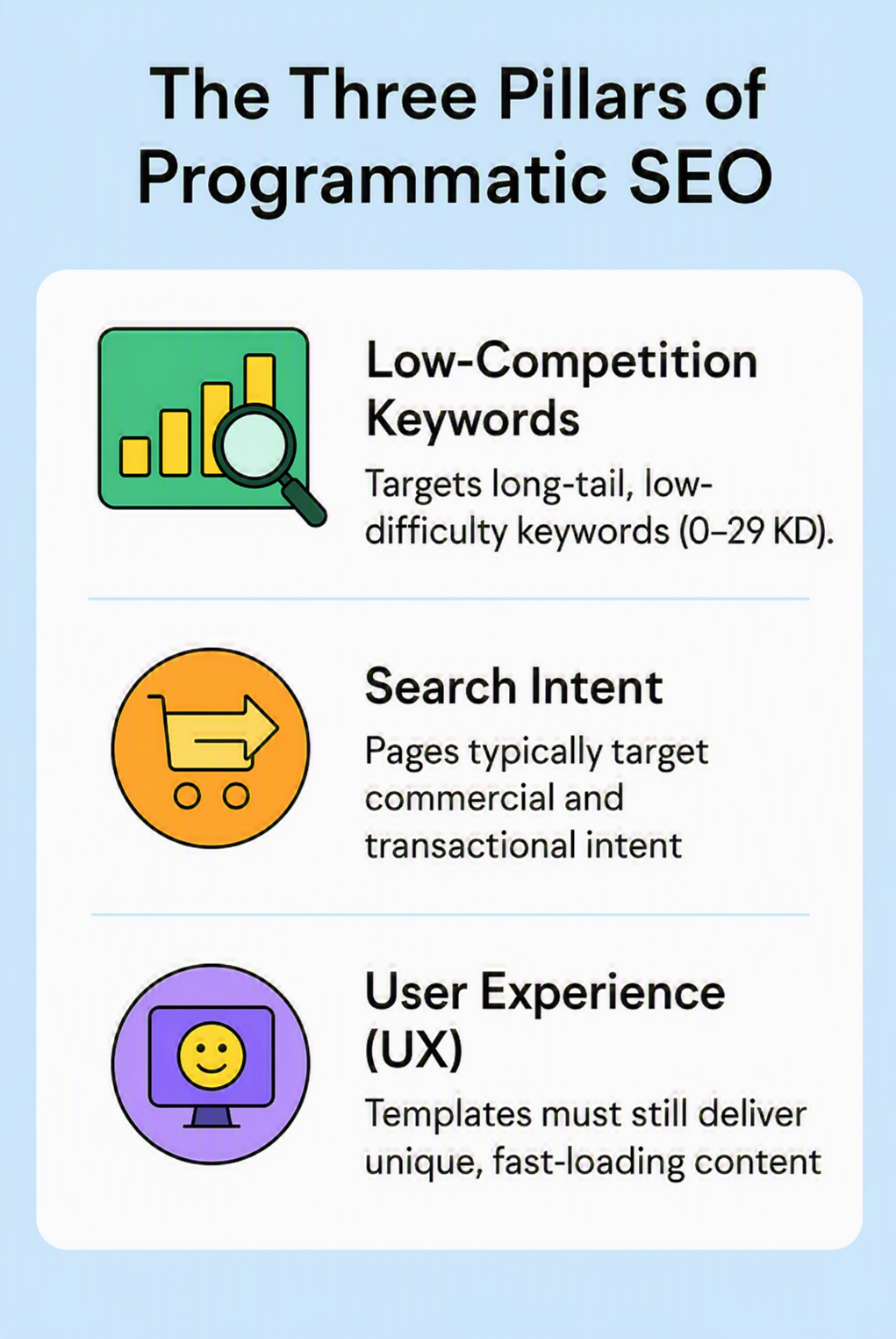
Automation helps with scale, but quality depends on the strength of the data, template logic, and QA process.
Keyword Types to Target
Programmatic SEO works best for keyword sets with repeatable patterns. These often include:
- Head terms, such as “hotels,” “software,” “parts,” or “services”
- Modifiers, such as “near me,” “best,” “cheap,” “for small business,” or “in Chicago”
- Long-tail keywords, such as “best luxury hotels in Miami for couples” or “replacement parts for Maytag dishwasher model X”
Long-tail keywords are especially valuable because they often have clearer transactional intent and are easier to map to structured page templates.
When Programmatic SEO Makes Sense
Programmatic SEO is useful when a business has many pages to create from structured data or repeated search patterns.
Common use cases include:
- Ecommerce product, category, and comparison pages
- Marketplaces with many listings
- Location and service area pages
- Product or service variation pages
- Travel destination pages
- SaaS integration pages
- Real estate, job, or business directories
Programmatic SEO is not always the right fit. A small website with limited data, a niche blog, or a business with only a few services may be better served by traditional SEO content. Programmatic SEO requires enough data, search demand, and page variation to justify the setup.
Real-World Programmatic SEO Examples
Programmatic SEO is common across large websites that need to target many related queries.
| Example | How They Use Programmatic SEO |
|---|---|
TripAdvisor | Generate destination and attraction pages using location, review, and activity data |
Wise | Generate thousands of currency conversion pages featuring current, historic, and comparative rate information |
Zapier | Create pages for their app directory, showcasing thousands of tools and workflow automations |
Ecommerce Sites | Create product, category, and comparison pages from product data and filters |
Directories | Generate pages by location, service type, category, or listing attributes |
The common thread is that each page is built from a repeatable data pattern. But the best examples still provide useful, page-specific information.
Programmatic SEO Tools
The right programmatic SEO tool depends on the specific workflow in question. But in general, teams will need tools for keyword research, data management, template creation, automation, publishing, and QA.
| Tool Category | Common Uses |
|---|---|
Keyword Research | Find scalable keyword patterns, modifiers, and long-tail opportunities |
Data Management | Organize product, location, listing, or service data in spreadsheets, databases, or a CMS |
CMS & Page Templates | Create reusable layouts that pull from structured data |
APIs & Automation Tools | Connect data sources, publishing workflows, and website templates |
QA & Crawling Tools | Check crawlability, indexation, duplication, metadata, and internal linking |
AI-Powered Content Tools | Improve metadata, descriptions, FAQs, and supporting copy when grounded in structured inputs |
AI tools can support the workflow, but they are not the same as programmatic SEO itself. Programmatic SEO relies on templates and structured data. But AI can help refine copy, metadata, and page elements when outputs are reviewed and grounded in accurate information.
CMS, API, & Data Integration
Programmatic SEO often depends on connecting structured data to website templates. This may happen through a CMS, a headless CMS, a database, APIs, automation tools, or custom scripts.
The main requirement is that the system can map data fields to the correct page elements. For example:
| Data Field | Page Element |
|---|---|
City | URL, H1, metadata, body copy |
Product Type | Category heading, intro copy, internal links |
Feature | Comparison content, filters, FAQs |
Review Score | Trust signals, listing content |
Service Area | Location page copy, schema, contact details |
The more organized the data, the easier it is to create useful programmatic pages at scale.
Programmatic SEO Implementation in 8 Steps
A strong programmatic SEO project should follow a structured process:
- Research competitors and keywords – Identify long-tail search patterns, repeatable modifiers, and the page types your competitors are ranking for.
- Define the page set – Decide which pages should be created and why they deserve to exist.
- Structure the data – Gather and clean the data that will populate each page.
- Design the template – Create a page layout with dynamic fields for content, metadata, internal links, and calls to action.
- Map fields to page elements – Connect each data point to the correct title, heading, copy block, image, link, or schema field.
- Publish in stages – Avoid launching thousands of pages without QA. Start with a controlled set.
- Optimize for SEO and UX – Review internal links, metadata, structured data, page speed, crawlability, and content quality.
- Measure and refine – Monitor indexing, rankings, clicks, conversions, and page quality. Improve or remove weak pages.
Common Challenges & Mistakes
Programmatic SEO can create significant organic growth, but poor execution can create low-value pages at scale. Common risks include:
| Challenge | Why It Matters |
|---|---|
| Thin or duplicate pages | Pages may not provide enough unique value |
| Weak data sets | Shallow data creates shallow pages |
| Repetitive templates | Too much sameness can weaken quality and user experience |
| Poor internal linking | Pages may become hard for users and search engines to find |
| Weak indexation strategy | Low-value URLs may get indexed while important pages are missed |
| Overpublishing | Too many pages may be launched before quality is proven |
| Slow page performance | Large page sets still need to load quickly |
| Lack of QA | Errors can scale as quickly as pages do |
A good programmatic SEO system needs planning, testing, and ongoing review. The goal is not to publish the most pages. The goal is to publish the right pages with enough value to satisfy the searcher.
Google Spam Policies on Scaled Content
Google’s spam policies address scaled content abuse, including pages generated primarily to manipulate rankings rather than help users. The issue is not automation, templates, or AI by themselves. The issue is low-value scaled content that does not provide meaningful benefit.
To reduce risk, each page should:
- Serve a distinct search intent
- Include useful page-specific information
- Avoid thin or duplicate copy
- Use accurate data
- Provide a helpful user experience
- Fit into a clear internal linking and indexation strategy
Programmatic SEO should be built for users first, with automation supporting the process.
Technical SEO Must-Haves
Technical SEO is critical for programmatic page sets because small issues can affect many URLs at once. Key requirements include:
- XML sitemaps for important page sets
- Crawlable internal links
- Clear canonical rules
- Strong indexation strategy
- Structured data where useful
- Clean URL patterns
- Accurate metadata
- Regular monitoring in Google Search Console
- QA checks after publishing
Technical SEO should be part of the workflow before, during, and after launch.
How Americaneagle.com Can Help with Programmatic SEO
For ecommerce sites, marketplaces, directories, SaaS platforms and location-based businesses, programmatic SEO can be a powerful way to expand organic visibility. The key is building a system that scales value, not just URLs. That requires the right keyword strategy, data structure, page templates, technical implementation, QA process, and long-term optimization plan.
Americaneagle.com helps businesses evaluate whether programmatic SEO is the right fit, identify scalable keyword opportunities, organize structured data, and design page templates. We can also support CMS and API implementation, plan internal linking, manage indexation, and create governance processes that keep scaled pages useful and search-friendly. Learn more about our digital marketing services and contact us to start a discussion.