


Every marketing leader I have been listening to or talking to in the last six months is staring at the same question: what will digital marketing channels even look like in five years?
AI is already reshaping how people discover and consume content. Search results are turning into answers (AEO). AI-generated experiences are replacing traditional navigation paths. In many cases, users no longer click at all. They get what they need, instantly, without ever visiting a traditional website. And that’s just the beginning.
It’s tempting to take a wait-and-see approach. To hold off on major investments until the picture becomes clearer. But there’s a problem with that strategy: by the time the channel landscape stabilizes, the brands that will win have already made their move. Value engineers wrap that up into what they call, “the cost of doing nothing,” and that cost is very real.
While the channels themselves are uncertain, there is one layer of your digital ecosystem that will thrive no matter what comes next and investing in it now is one of the few marketing solution decisions you can make with confidence.

Keeping CMOs Awake at Night
Seasoned marketers that put their SEO on autopilot are watching their traditional digital playbook break down in real time.
Search engines, the primary driver of traffic for most organizations for the past two decades, are evolving into answer engines. In 2026, nearly two-thirds of searches end without a click, as AI-generated summaries deliver information directly on the results page. It is your new normal. It’s okay, you can admit it.
AI Overviews now appear on roughly half of all Google queries, fundamentally changing how brands are discovered. At the same time, entirely new interaction models are emerging. AI assistants, conversational interfaces, and dynamically generated experiences are replacing static pages. The concept of a “session,” where a user arrives on your site and navigates through predefined paths, is rapidly becoming outdated.
Which leads to a critical strategic question: if the channels you’ve built your digital strategy around are changing this quickly, where do you anchor your investment?
Keep Calm & Content On
While the channels are evolving, the underlying truth is not: Content is still the fuel.
Every digital experience—whether it’s a traditional website, a mobile app, or an AI-generated response—has to be built from something. Images. Video. Product data. Copy. Brand elements. Even your favorite GIFS and memes. These assets are required and production rate is increasing to meet all of the channels and consumption.
Something always has to populate the experience, and that “something” is your content.
Organizations that thrive in this new environment will be the ones that can access, govern, and activate their content quickly, regardless of where it needs to show up. A centralized, well-structured content library allows teams to create, find, and deliver consistent, on-brand experiences across channels, markets, and formats.
On the flip side, organizations without that foundation will struggle to keep up. This is a problem I hear every month. “We cannot find our assets, they are spread all over.” “Our team is small and shrinking.”
The Volume Problem Is Getting Worse
If content were static, all of this would be easily manageable. But it isn’t.
AI is enabling accelerated content production at an unprecedented pace. Generative tools enable teams to create more assets, more variations, and more personalized experiences than ever before. Sure, we may scoff. But we as a society are accepting AI-created images, copy and oh yes, video, especially in the :15 or :30 TV spot.
The result? Content volume is being turned up to 11!
As I mentioned, most enterprise organizations are already struggling to manage the assets they have. Spread across shared drives, cloud folders, and disconnected systems, files are often duplicated, outdated, or missing entirely. Teams recreate assets that already exist, while others unknowingly use outdated or unapproved/unlicensed versions. Now multiply that problem by ten and then do that again.
Without the right infrastructure, more content doesn’t create more value. It just creates more chaos.
This is where metadata becomes the hidden variable. Well-structured metadata, which includes tags, taxonomy, and contextual data, is what makes content discoverable, usable, actionable, and measurable. It’s what allows teams (and you guessed it, AI systems) to find the right asset at the right moment.
This is why structured metadata plays an important role in determining whether AI can successfully deliver value from your content ecosystem. Without it, AI doesn’t solve your content problems—it amplifies them.

Why DAM + Content Operations Is the Answer
This is why the smartest investment organizations can make right now isn’t tied to any specific channel. It’s tied to the infrastructure beneath them: Digital Asset Management (DAM) and Content Operations.
Unlike a content management system (CMS), which is inherently tied to how content is presented in a given channel (often public web or intranet), DAM and Content Operations platforms sit below the presentation layer. They are channel-agnostic by design, serving as the foundation for how content is created, managed, governed, and delivered across the entire ecosystem.
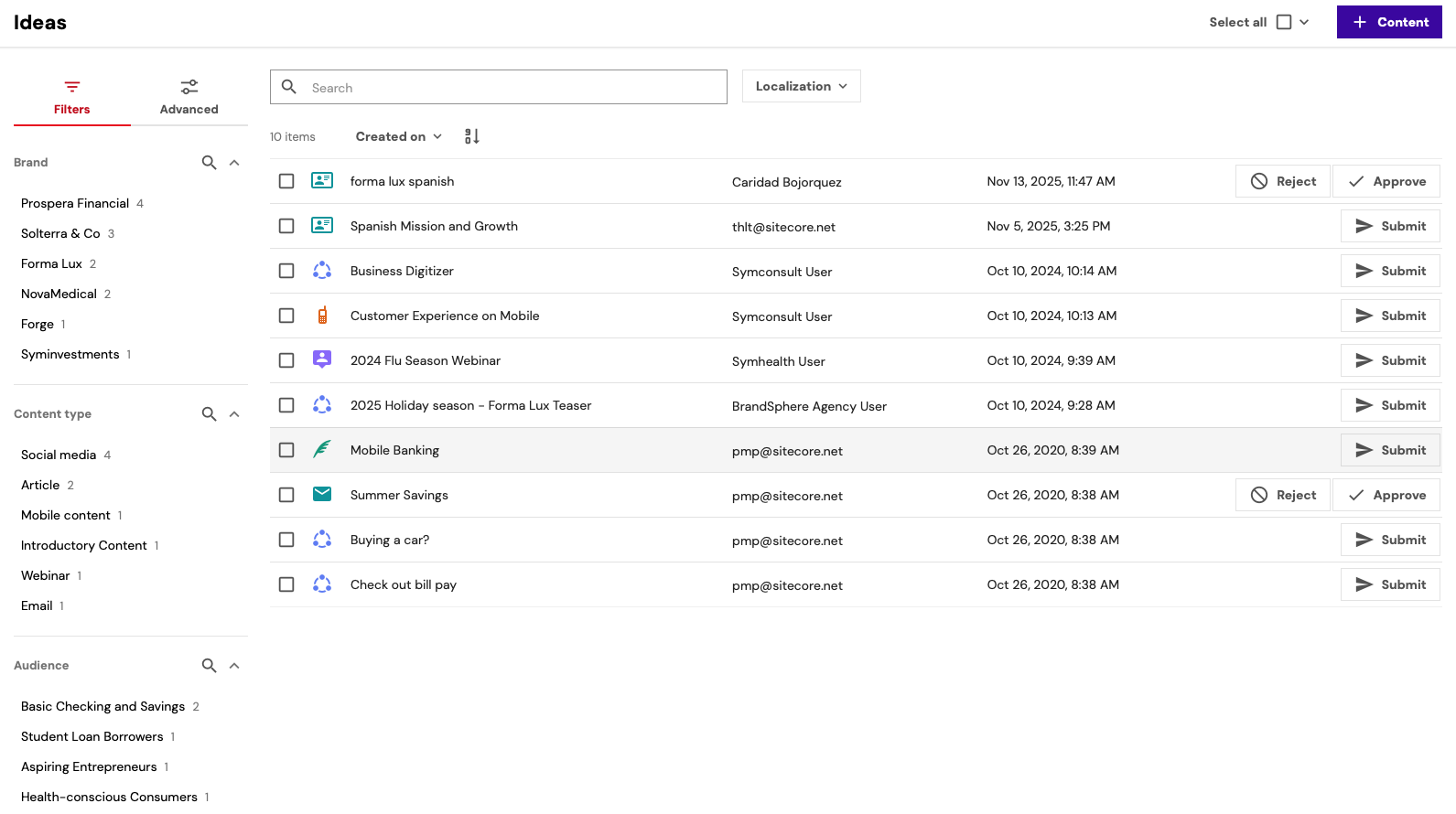
Sitecore Content Hub brings this foundation together into a single platform that manages the full content supply chain:
Research → Brief → Create → Approve → Deliver → Measure → Reuse/Retire
At its core is a centralized, governed asset library that becomes the single source of truth for all brand content. With AI-powered tagging and metadata enrichment, assets are automatically categorized and surfaced quickly through natural language and visual search.
But Sitecore Content Hub goes beyond metadata-tagged storage. Its Content Operations capabilities support campaign planning, Research, Smart Briefs, workflow orchestration, localization at scale, and performance tracking. Together, these features connect every step of the content lifecycle into a cohesive system. Plus, AI is already built into the platform at a foundational level.
SitecoreAI enables teams to draft ideas, generate briefs, translate content, and automate workflows through assistants and agents that operate across the content lifecycle. Agentic Studio extends this further, allowing teams to orchestrate multi-step workflows with autonomous agents that plan, execute, and optimize marketing processes. The result is a system where AI is actively working for your brand.
The Proof
Organizations that have invested in Sitecore Content Hub are already seeing measurable results:
- Foodstuffs New Zealand achieved a 50% improvement in asset reuse while managing over 700,000 assets in a centralized system.
- First Abu Dhabi Bank saw a 50% increase in productivity for their content team.
- VELUX improved efficiency by roughly 30% with automated web editing processes and enhanced site performance.
- Michelin Guide saw a 96% reduction in publishing timescales.
- Other enterprises have reported significant gains in productivity, faster content deployment, and the ability to manage massive global asset libraries with consistency and control.
When content is structured, governed, and accessible, everything moves faster, and every asset delivers more value.
Build for What Survives
After more than a decade in the Sitecore strategy space, advising enterprise organizations through digital transformations, one pattern continues to repeat itself: The companies that have their content house in order adapt quicker to changes in the digital marketing landscape.
Because when a new channel emerges, speed matters. The ability to connect and activate content quickly (to repurpose, localize, personalize, and deploy at scale) is what separates leaders from laggards.
Right now, the digital future is evolving rapidly. But your investment strategy can have a solid foundation. Anchor it in the layer that survives every channel shift.
Start with your DAM and Content Operations.
If you’re evaluating how to build a more resilient, AI-ready content foundation, the Americaneagle.com team can help you define your Sitecore Content Hub strategy and deliver a solution designed for whatever comes next. Contact us today to get started.