


Local PPC advertising, especially when combined with Google Business Profiles, is one of the most effective ways for banks, credit unions, and other financial institutions to increase visibility and attract nearby customers. Financial institutions can use PPC for banks to create highly targeted campaigns that connect with their local audience. Google Ads for banks offers a strong platform to boost traffic and generate leads, while local PPC advertising makes sure that your ads are seen by people most likely interested in your financial products.
PPC (pay-per-click) advertising, or paid search marketing, when done right, is an effective way for banks and credit unions to boost their local visibility and reach potential customers in their geographic area. Although organic traffic is important, geo-targeting, local keyword targeting, local ad extension, remarketing, and other PPC lead generation strategies are effective ways banks and credit unions can target and reach potential customers within their local service areas. As a result, they’re increasing visibility and driving more foot traffic to physical locations.
Integrating PPC with Google Business listings combines the precision of PPC ads with the visibility of Google Business listings. This is an excellent way to reach local audiences at the moment they express intent, thereby maximizing their chances of conversion. This integration also enables businesses to leverage location-based targeting, resulting in higher relevance and engagement with local consumers.
Also, featuring good reviews from Google and clear CTAs for getting directions can significantly boost the credibility of local advertising efforts and drive higher foot traffic to physical locations.
Bank advertising through PPC for financial services is one of the best ways to increase local visibility.
What is Local Pay-Per-Click (PPC) Advertising for Banks and Credit Unions?
Local PPC advertising is a digital marketing strategy for banks and credit unions that targets potential customers within a specific geographic area.
Unlike traditional bank advertising, which relies on broad strategies like billboards, print ads, radio ads, or TV commercials, PPC advertising is highly targeted and measurable. Traditional advertising casts a wide net, aiming to reach a general audience, while PPC allows financial institutions to target users actively searching for specific services, such as "community bank near me" or "credit union in [city]." This precision ensures that advertising budgets are spent on reaching people with a clear intent to engage with local banking services.
For example, community bank PPC campaigns can target users searching for personalized banking experiences in their area, while credit union PPC campaigns might focus on promoting member benefits to nearby residents. Financial services PPC can include a wider range of offerings, such as loans, mortgages, or investment services, tailored to local needs. Additionally, local PPC marketing enables banks and credit unions to appear in Google Search and Google Maps results for terms like "local bank branch" or "credit union near me". This approach helps boost foot traffic and new accounts by directing users to nearby branches, ultimately enhancing the bank or credit union's local visibility and accessibility.
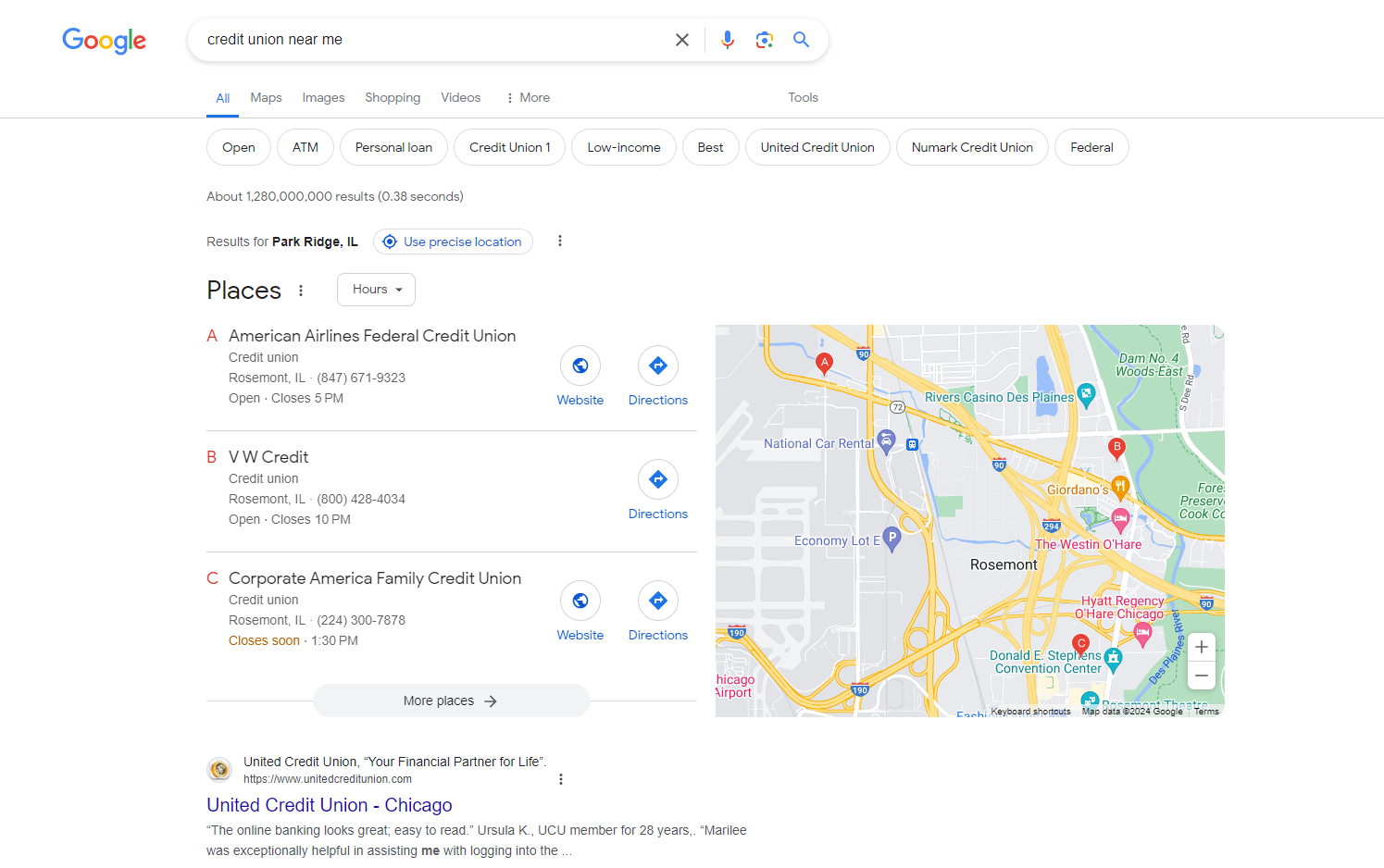
Below is an example of ads displayed in the Google Map Pack when searching for "credit union near me," with the searcher's location in Park Ridge, Illinois.
The Role of Google Business in Local PPC Strategies
Why Google Business Profiles Matter for Financial Services Ads
Google Business Profiles are essential for financial services ads because they enhance visibility in the local map pack, a prime spot for attracting nearby customers. For credit unions, appearing in the map pack through PPC campaigns and Google Ads increases the chances of being discovered by users searching for "credit union near me" or similar terms. This visibility drives foot traffic, builds trust through reviews, and ensures potential members can easily find and engage with local branches.
Integrating Performance Max with Google Business
Integrating Performance Max (PMax) with Google Business Profiles (GBP) allows financial institutions to maximize their local advertising efforts through advanced geo-targeting and optimization. By combining GBP's local map visibility with PMax's AI-driven ad placements, banks and credit unions can target specific geographic areas and deliver tailored ads to users actively searching for nearby financial services.
Creating Local PPC Ad Variations for Banks and Financial Institutions
Digital advertising often relies on automation to deliver the most relevant and highly converting ad copies to users. By providing a variety of appealing ad variations centered on specific themes, advertisers can significantly boost overall ad performance. This method enables automated systems to optimize and serve compelling ad content that effectively connects with the target audience, ultimately increasing engagement and conversions.
In the banking sector, PPC campaigns often use dynamic ad formats to showcase personalized offers, such as promoting nearby branch locations or highlighting specific financial products. For example, Google Ads Responsive Search Ads can display segmented copy tailored to different services like credit cards, mortgages, or checking accounts, ensuring the right message reaches the right audience. Providing ad variations that appeal to key target audiences is effective because it allows advertisers to customize their messaging to resonate with particular segments of their audience. By offering diverse themes, advertisers can create a cumulative effect on the target audience, reinforcing brand messaging and engaging users across various touchpoints.
Google Ads excels at showcasing the best-performing ad variations, but ensuring these systems are supplied with unique, high-quality ad content is a key part of PPC ad management for financial services. Professional PPC management services focus on optimizing campaigns, refining ad copy, and leveraging automation to improve performance.
Reputation-Focused Ad Copy for Bank PPC Ads
When developing reputation-focused ad copy for bank PPC campaigns, it's important to emphasize aspects that resonate with potential customers seeking excellent customer service and trustworthiness. Featuring trust signals, such as being "FDIC insured," can reassure users about your financial institution's safety and credibility. Additionally, incorporating reviews from Google Business Profiles into your ad copy can showcase real customer experiences, further enhancing trust and encouraging engagement. Adding these elements to your ad copy can strongly appeal to customers who value good service. Working with a bank PPC firm can help refine these strategies, ensuring your ads effectively convey reliability and trust.
Tangible Incentives and Sign Ups for Bank PPC Ads
It’s crucial for your bank PPC to include ad copy that provides clear incentives to customers applying for a new account or loan. For example, promotions like “Get $250 when you open an account” can be very effective in capturing attention and increasing conversions. Additionally, using seasonal targeting by adjusting your local pay-per-click budget during key times of the year—such as tax season, back-to-school, or holidays—can help optimize ad performance and attract customers when they are most likely to need financial services.
Community-Focused Bank PPC Ads
Highlighting your long-standing service to the community as a bank or credit union is a powerful way to build credibility and trust with potential customers. For example, ad copy like “Proudly serving [City] since 1954” not only emphasizes your established presence but also reinforces your commitment to the local area. Additionally, showcasing involvement in local community events, such as sponsoring charity drives or participating in neighborhood initiatives, can further improve your reputation as a trusted financial partner.
Working with a community bank PPC company can help craft ad campaigns that effectively communicate these values while targeting the right audience. By combining this messaging with local business PPC strategies, you can connect with customers who value community-focused institutions.
Local PPC Campaign Management for Banks, Credit Unions, and Financial Services
In PPC campaign management for banks and credit unions, ongoing oversight and improvement are essential for success. For credit unions specifically, managing PPC ads is crucial for reaching local communities and promoting member-centered services. By continually refining and expanding targeting efforts, financial institutions can effectively reach their desired audience while experimenting with new strategies like remarketing to abandoned applications to re-engage potential customers.
Best practices, such as tracking key performance indicators (KPIs) like Cost Per Acquisition (CPA), Click-Through Rate (CTR), and Return on Ad Spend (ROAS), are essential for measuring success and making data-driven decisions. Budget planning is another vital element, ensuring resources are allocated effectively to high-performing campaigns while using geo-segmentation techniques to target specific regions or neighborhoods. This approach allows banks and credit unions to customize their messaging to local audiences, maximizing relevance and engagement. Retaining high-performing ads, refining those that underperform, and consistently measuring results enable financial institutions to optimize their campaigns, improve ROI, and maintain a strong competitive edge.
Managing PPC Ad Budgets for Banks
Effectively managing PPC ad budgets is crucial for banks to ensure they get the most out of their advertising spend while maintaining a profitable return on investment (ROI). Here are some key points about the importance of and keys to managing PPC ad budgets for banks:
- Cost control: PPC advertising can quickly become expensive if not managed properly, eating into marketing budgets and impacting profitability.
- Maximum exposure: With a well-managed budget, banks can ensure their ads are shown to the right audience at the right time, maximizing visibility and potential customer acquisition.
- Competitive edge: Effective budget management allows banks and credit unions to better allocate resources and outbid competitors for high-value keywords and target markets.
Some of the main keys to managing PPC for financial services budgets include:
- Set realistic goals and budget limits aligned with business objectives and marketing strategies.
- Continuously monitor and analyze campaign performance metrics like cost-per-click (CPC), conversion rates, and cost-per-acquisition (CPA) to identify areas for improvement.
- Allocate budge resources towards top-performing campaigns, ad groups, and keywords.
- Regularly review and refine negative keyword lists to prevent irrelevant clicks and wasted spend.
- Utilize automated bid strategies to maximize conversions within set budget limits.
- Track seasonal trends and adjust budgets accordingly to capitalize on peak interest periods.
Here’s a table summarizing key aspects of PPC budget management for banks, including example CPCs, budget splits, and the role of effective paid ad management:
Category | Details |
|---|---|
Example CPCs | |
Branded Keywords | $1.50 - $3.00 CPC (e.g., "ABC Bank checking account") |
Non-Branded Keywords | $4.00 - $8.00 CPC (e.g., "best savings account near me") |
Budget Split | |
Search Ads | 60% - Focus on high-intent keywords to drive conversions |
Display Ads | 20% - Build brand awareness and retarget users with visual ads |
Remarketing | 20% - Re-engage users who abandoned applications or visited the website without converting |
Best Practices | |
Paid Ad Management for Banks | Regularly monitor KPIs like CPA, CTR, and ROAS to ensure campaigns are cost-effective |
Bank PPC Management | Use geo-segmentation to target specific regions and allocate budgets to high-performing areas |
Seasonal Adjustments | Shift budgets during peak periods (e.g., tax season, back-to-school) to capture increased demand |
By leveraging these strategies, banks and credit unions can optimize their PPC campaigns, ensuring cost-effectiveness and maximum ROI. Partnering with a professional bank PPC management service can further enhance campaign performance by implementing advanced techniques like automated bidding, negative keyword refinement, and audience segmentation.
Measuring Bank PPC Campaign Success
Google automatically tracks the number of phone calls and direction requests from PPC ads, making overall performance monitoring easier. These metrics, along with form submissions and click-through rates (CTR), are key because they account for the majority of conversions for such ads. Phone calls can also be call-tracked and recorded, allowing for detailed performance analysis and helping to improve strategies for better results.
Setting up website actions as goals within Google Analytics enables comprehensive tracking of user interactions, such as form submissions or appointment bookings, providing valuable insights into the effectiveness of a PPC campaign for financial sites. Additionally, focusing on improving Quality Score and conversion rates is essential for a successful local PPC strategy, as higher Quality Scores lower costs and enhance ad placements. Leveraging these metrics ensures better cost-per-conversion and stronger branding within targeted local communities.
How PPC Supports Local SEO, Social Media, and Banking Website Strategies
Integrating local PPC ads with your overall digital marketing strategy is vital for achieving maximum results. Coordinating PPC efforts with local SEO for banks ensures that your financial institution ranks highly in both paid and organic search results, boosting visibility and trust among potential customers. A combined approach using PPC and SEO is especially effective for enhancing brand visibility because it helps you attract high-intent search traffic through ads while also establishing a strong organic presence over time.
The synergy among digital advertising in financial services, PPC, organic SEO, email marketing, social media, and other digital efforts creates a unified and thorough approach to reaching and engaging the target audience. Improving landing page content and quality scoring are vital for boosting the landing page quality score, which ultimately leads to better ad performance and user experience. Consistent optimization across all digital marketing channels is essential for overall marketing success.
Geo-Targeting and Keyword Strategies for Local PPC Ads
Geo-targeting is a powerful tool for local PPC ads, enabling financial institutions to target specific areas with radius targeting, ZIP code targeting, and geo-customizers. These strategies ensure ads are displayed to users in the most relevant locations, maximizing efficiency and engagement. For example, ads like “low APR loans near [City]” can dynamically adapt to the user’s location, creating a personalized experience that boosts click-through rates. Incorporating long-tail keyword targeting, such as “best credit union for mortgages in [City],” further refines audience reach by capturing users with specific search intent. Partnering with a local PPC company can help financial institutions implement these strategies effectively, ensuring their campaigns are optimized for both visibility and conversions.
Compliance and PPC Ad Policy for Financial Institutions
Compliance is a critical aspect of running successful PPC campaigns for financial institutions, as the industry is heavily regulated. Ads bank on trust and transparency, which is why including proper disclaimers—such as “Member FDIC” or “Equal Housing Lender”—is essential to meet legal requirements and build credibility. Additionally, platforms like Google Ads for banks have strict policies regarding restricted terms, such as “guaranteed approval” or “instant loans,” which must be avoided to prevent ad disapprovals or account suspensions. Regional rules also play a significant role, as financial institutions must ensure their campaigns adhere to local advertising laws and guidelines. Non-compliance can lead to big fines, reputational damage, and even the suspension of PPC accounts.
Local PPC Success with Americaneagle.com
Our data-driven methodology ensures that your PPC for financial services produces the results you need to stay at the forefront of local PPC. As a trusted bank PPC firm delivering results for financial services organizations, we provide paid search management to help you maximize your PPC ad spend. We also offer a comprehensive paid search audit to evaluate your campaign’s performance and identify areas for improvement. Check out some of our financial institution successes!
Contact us today and partner with Americaneagle.com to boost visibility, attract new customers, and solidify your position as a leading bank or credit union in your local community.
FAQs for Local PPC Ads for Banks & Credit Unions
What does PPC stand for in banking and how does it work for local banks?
PPC (Pay-Per-Click) in banking is a digital advertising model where banks pay for each click on their ads. Local PPC for financial institutions focuses on intent-based targeting using keywords like "banks near me" or "credit unions in [location]." Unlike traditional digital ads, local PPC uses geo-targeting to reach nearby customers. Platforms like Google Ads, Performance Max, and Local Service Ads help banks appear in search results, maps, and local packs, driving foot traffic and conversions.
Why should community banks and credit unions invest in local PPC advertising?
Local PPC for credit unions boosts brand visibility, attracts local customers, and drives foot traffic. Community bank PPC strategies allow smaller institutions to compete with national banks by leveraging geo-targeting and community-specific offers. With lower CPCs compared to traditional advertising, local PPC delivers a higher ROI, making it a cost-effective way to grow in local markets.
How do Google Business profiles enhance local PPC campaigns for financial services?
Google Business profiles improve ad placement in Google Maps and the local pack, increasing visibility for financial institutions. When integrated with Performance Max campaigns, they enhance targeting and drive higher CTRs from map results. This synergy, part of a strong Google Business PPC strategy, increases phone calls, direction clicks, and overall engagement for banks and credit unions.
How much should banks budget for local PPC campaigns?
Banks should expect CPCs for financial services keywords to range from $2–$10+, depending on competition and location. Budget allocation can vary: 60% for brand awareness, 40% for customer acquisition. Seasonal fluctuations, competitive bidding, and geographic targeting influence costs. Studies on PPC for financial services suggest adjusting budgets during peak periods like tax season for maximum ROI.
What are the best ad types for banks running local PPC campaigns?
Search ads are ideal for branch visits and loan signups, while Display ads build brand awareness. Local Service Ads work well for driving calls and appointments, and Responsive Ads adapt to user intent. Bank PPC ad formats with call extensions, location extensions, and structured snippets enhance visibility and engagement.
What KPIs should banks track to measure local PPC ad success?
Key KPIs include CTR, CPC, CPA, Conversion Rate, Phone Calls, and Direction Clicks. Call tracking, GA4 goal setup, and custom event triggers are essential for measuring PPC campaign performance for banks. These metrics help evaluate ROI and optimize PPC analytics in banking for better results.
How can local PPC marketing help banks compete with national brands?
Local PPC marketing for banks leverages geo-targeting, hyper-local copy, and community-specific offers to dominate local keywords like “mortgage lenders in Naperville.” With lower competition for long-tail keywords, PPC for financial institutions ensures cost-effective campaigns that can help local banks outperform national ones in their communities.
Can local PPC campaigns integrate with SEO and other bank marketing channels?
Yes, local PPC marketing for banks complements SEO by testing keywords and dominating SERPs. PPC and SEO for banks can integrate with email campaigns, CRM retargeting, and social ads to create an omnichannel PPC strategy.
What compliance rules should banks follow when running PPC ads?
Banks must adhere to Google Ads financial policies, CFPB regulations, and the Truth in Lending Act. Avoid misleading terms like “guaranteed approval” and include disclaimers like “Member FDIC.” Routine reviews of ad copy and disclaimers ensure financial PPC ad compliance and prevent legal issues with PPC ads for banks.
How can Americaneagle.com help with local PPC ad management for banks?
Americaneagle.com specializes in PPC for banks and credit unions, offering services like campaign audits, budget optimization, ad testing, and performance reporting. As a trusted bank PPC firm, we also provide landing page design, Google Business profile setup, and multi-location PPC campaigns. Partner with us for expert local PPC management for banks and credit unions.