

Last year we walked out of the Symposium keynote, and it felt like the whole world (of Sitecore) had changed. This year, my take after three days of keynotes, breakouts, partner sessions, and more coffee than I want to admit is that Sitecore delivered an evolution, and I mean that as a compliment. What I saw was a steady, connected next step for the platform Sitecore introduced a year ago as SitecoreAI, with the marketer at the center of it. It's deliberate, it's governed, and in a few places, it patches the vision that was created last year.
That matters if you run marketing or digital at a large organization. Almost every announcement this year asked you to connect what you already own and make it work harder. Very little asked you to tear anything down. That's good news for anyone who has spent the last decade investing in Sitecore. It also appeared to save the hair on (some of) the heads of several of my Sitecore Solution Engineer friends.
Americaneagle.com was in Orlando in force this year, and a few of us stayed longer than we planned. The day after Symposium wrapped, the FAA called a nationwide ground stop, and a lot of the Sitecore community ended up stranded in Orlando together. Six Americaneagle.com diehards decided not to wait it out and drove the 17 hours home to Chicago. Everyone made it home safe, and it's a memory of our team that I will never forget. Here’s the before photo. We opted out of the after (17 hours in a car together) photo.

Pictured from left to right: Americaneagle.com Sitecore MVPs Ahmed Okour, Alex Lentz, Maggie Burke, Rick Bauer, Casey Stanutz, and James Gregory
As an award-winning Sitecore Diamond Partner, we track Sitecore's product direction closely through partner briefings and enablement. So, in this recap I'll separate three things for you: what Sitecore announced, what's already live in the product, and where I think it's heading next.
Marketing Rewired: The Help We Need
The theme this year was "Marketing Rewired," and CEO Eric Stine opened with a comment that stuck with me when he said (in so many words) that as someone in sales, his focus is centered on helping. How do we help solve the problems modern marketers face day to day?
Sitecore Spent the Week Working to Help Marketers & Business Leaders
As I spent most of my time at the AI Search and Visibility booth, I heard the same stress points repeatedly. It was a common thread: buyers are asking AI assistants before they ever land on your site. Tim Sanders of G2 reinforced it on Day 2 with G2 research showing that 54% of software buyers say AI chatbots influence their vendor shortlist. Scrunch research shared on stage found that roughly 41% of AI sessions never leave the AI platform. In those sessions, nobody clicks through to a website. Treat both as research findings, but the direction is hard to argue with.
AI already shapes discovery. The open question for marketers is how quickly you can see what it says about you and respond.
MarketingIQ Was the Star of the Show
Sitecore introduced MarketingIQ on November 11, and it is the announcement I expect every Sitecore customer to ask about in the next 90 days. MarketingIQ is a new module inside SitecoreAI that connects what the market is telling you with what your company already knows, then puts people and AI agents to work on it.
Sitecore breaks it into two parts. One is contextual intelligence: a working knowledge of your brand, your products, your approved content, your objectives, and your past results. The other is AI agent orchestration, the part that lines up your people and agents to get the response done. Put those together and you get a loop. MarketingIQ spots an opportunity based on signals (or you hand it a goal), applies your brand and business context, assigns the work to agents, stages a proposed response for your review, and then measures whether that response improved visibility, brought in qualified traffic, and converted.
Sitecore's own example is a good one. An AI answer leaves your brand out or quotes a price that's a year out of date. Scrunch (acquired mid-year) flags it. MarketingIQ looks up your approved product facts, writes a proposed correction, and holds it until a marketer reviews, edits, and approves it. Sitecore was explicit that nothing goes live without a person signing off.
Seeing MarketingIQ in Action
The keynote demos made it concrete. One followed a marketer (“Kelly from the tele”) at a performance running shoe brand who discovered, through Scrunch, that people were asking AI assistants which shoes work best for healthcare workers on twelve-hour shifts. Her brand wasn't part of those answers. MarketingIQ drew on the product catalog, inventory, approved messaging, and the asset library to recommend a product and a campaign, and agents produced the pages, social posts, and ads she then reviewed and approved. It was a vendor demo, so focus on the workflow more than the specifics.
Three details stood out to me.
First, MarketingIQ works where your marketers already work. Sitecore says marketers can reach supported capabilities from the assistants they already use (naming Claude, ChatGPT, Slack, and Microsoft Teams), while keeping your permissions and approvals intact. Part of the keynote demo ran from Claude, outside the SitecoreAI interface. Sitecore connects those assistants through APIs and Model Context Protocol, building on the Marketer MCP server and Agent API it has been rolling out this year.
Second, MarketingIQ works across third-party systems. Sitecore says teams can act across Sitecore and non-Sitecore CMS, DAM, CRM, and business applications without replacing them. “Most of our clients run a mixed stack” was the message.
Third, Sitecore kept people in charge. Marketers set strategy, shape the response, and approve the work. I've been making this argument in workshops and on stage all year, and I was glad to see it designed into the product from the start.
Getting Started with MarketingIQ
Now the practical part executives always ask me first: do we already own it? According to Sitecore, MarketingIQ comes with your SitecoreAI license with Scrunch entitlement, through either SitecoreAI CMS or SitecoreAI DAM, and is not sold separately. An XM or XP license by itself won't get you MarketingIQ, and neither will a Scrunch license by itself. Sitecore's announcement did not include a general availability date, but my expectation is that existing SitecoreAI customers will see it switch on soon. I'd look for the guided, goal-to-execution experiences to arrive first, and for more signal sources such as site analytics, search, and campaign results to follow in the not-too-distant future.
To get started, I think marketers should consider setting up a standing review. Give MarketingIQ a goal, say a revenue target for a product line, and decide up front which work can keep moving on its own and which work comes back to you. Swapping in an already approved image or updating a product detail when the source data changes might run on its own. Anything touching claims, prices, offers, budget, or a new market comes to a human. That split is a governance decision, and it's the conversation we as a partner would have with your team before you turn anything on.
Americaneagle.com is already putting this to work. We're running a pilot of MarketingIQ with our client Guidehouse, a global consultancy, building on the SitecoreAI foundation we put in place for them. Danny Sanchez, Director of Digital Marketing at Guidehouse, put it this way:
"We're a large organization serving diverse markets, which means our teams need to move quickly while delivering experiences that reflect the needs of different audiences. Our campaign briefs, assets, pages, and analytics need one integrated system. Building on the foundation Americaneagle.com put in place, Sitecore MarketingIQ brings all that work together, with agents that connect workflows and information so our team can focus on the strategic and creative decisions that matter most." - Danny Sanchez, Director of Digital Marketing, Guidehouse
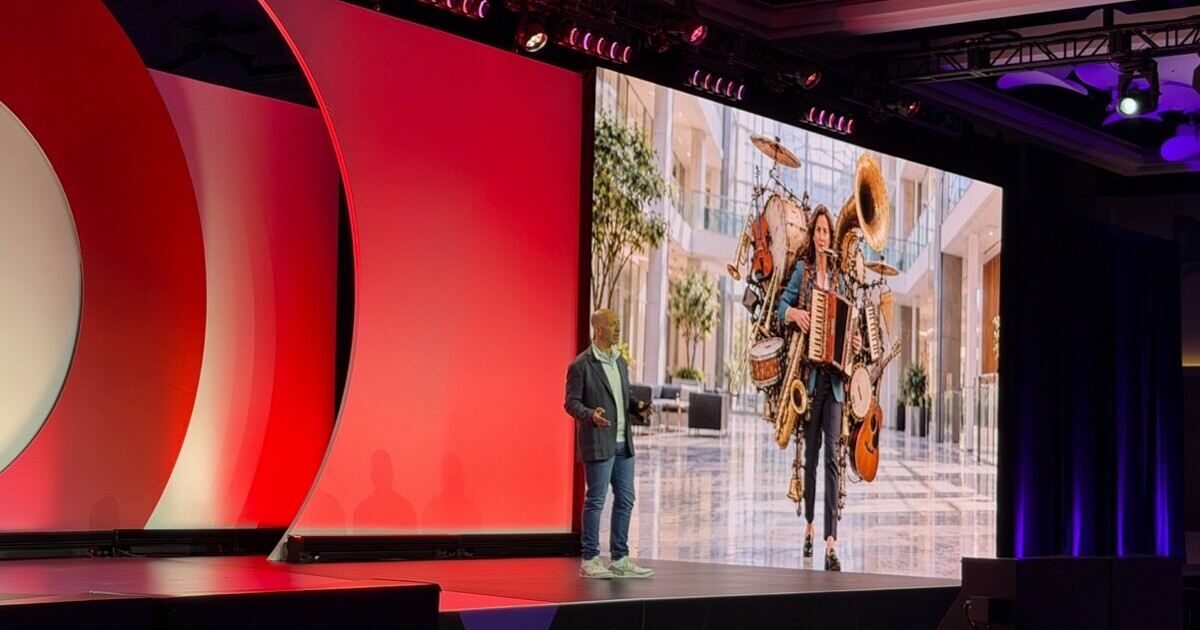
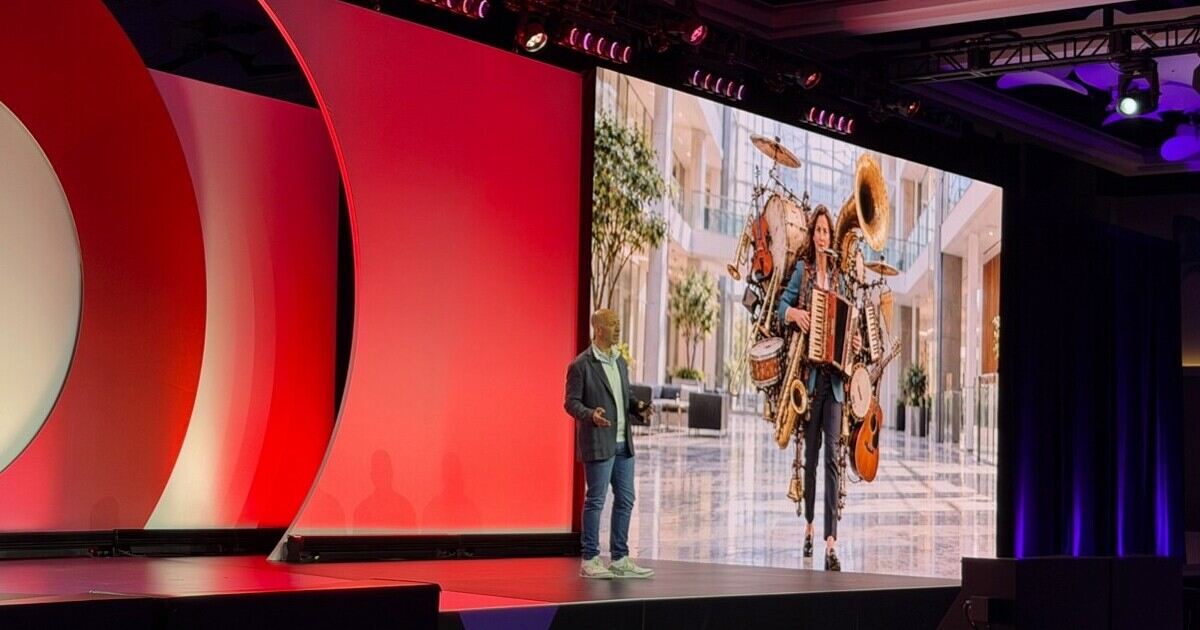
Eric Stine, CEO of Sitecore, speaks to the Symposium audience about the platform's new capabilities.
Scrunch Grows Up, & the Trial Runs Up to 12 Months
Sitecore acquired Scrunch in June, and Orlando solidified the value of that deal for Sitecore users. Scrunch shows how AI-generated answers describe your brand: where you're cited, where you're missing, and where competitors are gaining ground. MarketingIQ is what turns those findings (signals) into work.
On Day 2, Scrunch launched Citation Optimization, which shows the outside publications and review sites that AI answers lean on in your category, so you can decide where outreach will pay off. Scrunch also showed Imposter Detection for lookalike domains that misrepresent your brand, and laid out its direction for agent experiences, which is about making your content easier for AI agents to read and act on.
The announcement that deserves the most attention, though, is the simplest one. SitecoreAI customers get a Scrunch trial that lasts as long as 12 months. Since November 12, SitecoreAI CMS connects to Scrunch automatically for eligible organizations with a known public domain. Signals show up in Strategy, AEO opportunities in Channels, and page-level recommendations in Page Builder. The trial tracks a limited set of questions, pages, and AI platforms, so it is a taste of what is possible. A Scrunch Enterprise license expands the coverage.
If you are on SitecoreAI, this is the easiest decision you should have already made. Turn it on, look at your signals, and find out what AI assistants are saying about you. You may not like the answer. You'll want to know it anyway.
One more thing I tell every client: watch trends, make tweaks, work with experts. Nobody can push your content into ChatGPT or Gemini, and no tool controls what a model says. What you can do is make sure that when an AI assistant's retrieval bot comes to your site looking for current information, it finds accurate, approved, well-structured material. That's the job Scrunch and SitecoreAI are built to do together. As an added bonus: the morning briefing approach from Scrunch is a solid productivity booster!
Where DAM at Sitecore is Headed
This is the section I care about most personally. I've spent years inside Content Hub with clients, and I'm working through DAM and content operations training with clients right now. So let me separate what Sitecore has said publicly from where I think this is going.
Here's what's public: Sitecore now uses SitecoreAI DAM as its DAM name, and Content Hub customers keep their assets, workflows, and configuration. Scrunch Knowledge Studio can take approved content from SitecoreAI DAM or Content Hub and turn it into reviewed knowledge documents that AI tools can draw on. The week of Symposium, Sitecore added C2PA content credentials to Content Hub, so you can see whether an asset was AI-generated or modified and keep that provenance across renditions. On November 17, Sitecore released a DAM Assets API and DAM Context API in Early Access for both SitecoreAI DAM and Content Hub, which let developers find assets by text, by visual similarity, or by filter.
Now, if you ask me, I think the future of DAM at Sitecore has two front doors. This is just me speculating, based on what I've watched happen in the Sitecore space over the years, but I'd expect to see a simpler, governed DAM experience living right inside SitecoreAI, set up for you. There is a sense of this in the CMS already with the updated media tooling. I'd expect Content Hub to keep doing what it does best for organizations with complex workflows, product data, and content operations that call for deep configuration. If you're a Content Hub customer, I wouldn’t read anything from Orlando as a reason to worry. I read it as more investment in the same foundation.
I also expect the DAM to become something agents work through directly. I'd look for an MCP server that lets approved agents read and update asset metadata within your permissions, one asset picker used the same way everywhere in SitecoreAI, and provenance and AI-usage labeling that travel with the file to support transparency rules such as the EU AI Act.
If I'm right, the DAM work you've been putting off becomes urgent. Metadata, taxonomy, rights and expiration, product information, and approval workflows decide whether an agent picks the right asset or confidently picks the wrong one. Fix that foundation before you scale.
For more information, see my previous post on this topic: Why Content Infrastructure is the Foundation for Digital Success
Sitecore Advantage: Support that Shows Up Before You Call
Sitecore also introduced Sitecore Advantage, a new program that builds on Sitecore 360. In the keynote, Sitecore pitched it as proactive and forward-deployed, built to help customers use what they already pay for.
Sitecore's published terms describe Advisory Hours for expert guidance and Learning Seats for Sitecore's eLearning catalog in three tiers (Signature, Select, and Essential). Advisory Hours cover advice and exclude hands-on delivery such as implementation or migration, and Sitecore stressed in the keynote that Advantage is meant to work alongside partners.
As a former Sitecore employee who ran Inspiration Day workshops, I'll say this plainly: the adoption gap is painfully real. Sitecore shipped a lot in the last year, and shipping a feature doesn't mean a team uses it well. Sitecore shared that 98% of SitecoreAI customers have at least one SaaS customization and that customers and partners have built more than 1,000 agents. The organizations getting the most value pair Sitecore's product expertise with a partner who knows their business, their stack, and their people. That's how I'd use Advantage, and it's how we'll work alongside it.
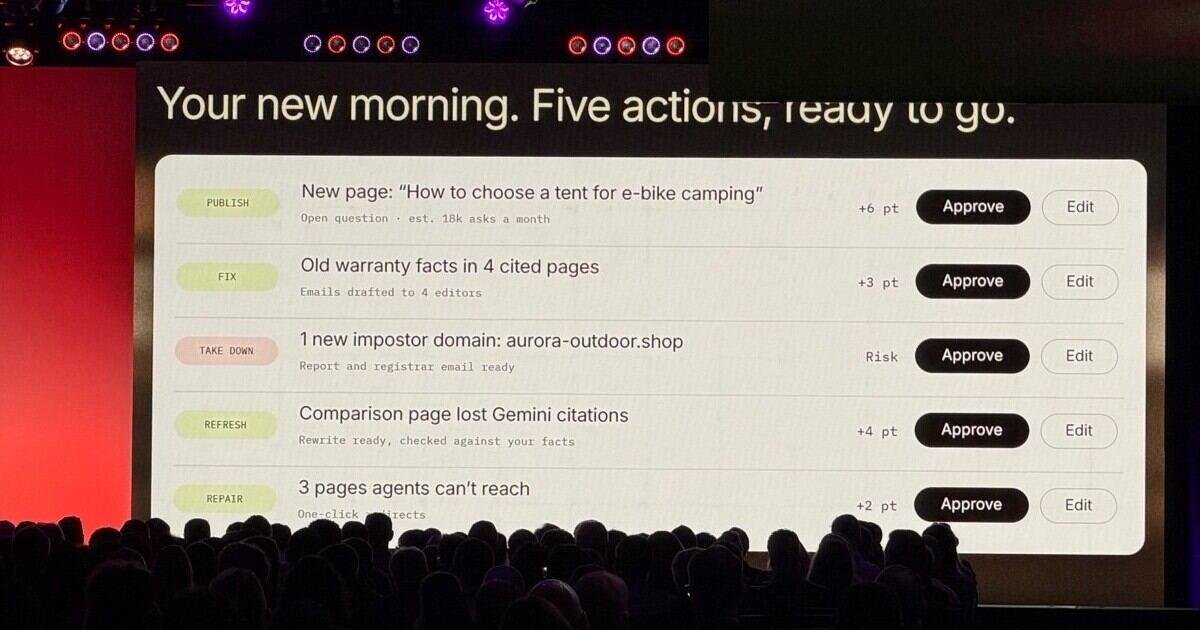
Sitecore Symposium presentations highlighted the platform’s latest innovations.
A Message for XM and XP Customers: Make 2027 the Year
To be direct (because I'd rather you hear it from me now than from your budget in 2028): If you are not on SitecoreAI, 2027 is the year to get there. The value and capabilities are real.
MarketingIQ comes with a SitecoreAI license, and an XM or XP license alone doesn't include it. Sitecore did describe ways to bridge the gap. If you're on XM or XP 10.2 or later and actively moving to SitecoreAI, you don't have to wait for the migration to finish. Sign SitecoreAI terms, add Scrunch, and you can start using MarketingIQ along the way.
In a product session, Sitecore showed MCP support for XM and XP 10.2 through 10.5, starting with reading and updating page copy. I expect Scrunch visibility to reach the XM interface for those same versions. Those are useful bridges and those bridges lead you toward SaaS. Americaneagle.com also has a powerful migration tool to help you cross that bridge efficiently.
Take a quick look at the calendar and the urgency becomes a little clearer. Under Sitecore's product support lifecycle, extended support for 10.0 and 10.1 ends on December 31 of this year. Extended support for 10.2 ends on December 31, 2027. Mainstream support for 10.4 ends the same day. Want to talk security? (Maybe you saw the news the entire week after Symposium.) On XM or XP, keeping up with security patches is your team's job. On SitecoreAI, Sitecore handles the platform.
Put that together and the math changes. If your version is already in Extended Support, every month you stay means paying more to stand still while SitecoreAI customers get MarketingIQ, the Scrunch trial, and the agent ecosystem that comes with them. The migration doesn't have to be a big-bang revolution either. Plan it in phases, use the bridges Sitecore offered, and fix your content and asset foundations along the way so you arrive ready to use what you're paying for.
Evolution, Not Revolution: What I'd Do in the Next 90 Days
I've run enough roadmapping workshops to know a recap only matters if it changes what you do on Monday. Here's where I'd start.
Turn on the Scrunch trial if you're on SitecoreAI and spend an hour with your signals. Find out where AI assistants mention you, cite you, or skip you, and which competitors show up instead.
Get your foundations in order before you scale agents. That means DAM metadata and rights, accurate product information, a configured brand kit, and a governed component library. Agents amplify whatever you give them, good or bad.
Decide your approval model now. Who can let an agent recommend a change, and who can let it publish one? Human review only works if the reviewer can see what the agent used, what it changed, and why. Build that into your workflows before the volume shows up.
If you're on XM or XP, put a SaaS migration plan on your 2027 roadmap with real dates, and use this quarter to scope it.
And if you missed Orlando, Sitecore is running Symposium on Tour in London on November 26 and a Digital Edition online on December 9.
Let's Talk About 2027
Americaneagle.com spends every day helping enterprise teams turn announcements like these into working programs. Whether you want to activate MarketingIQ and Scrunch on SitecoreAI, get your DAM and content operations agent-ready, or plan a phased move from XM or XP to SaaS, we'd love to help you map the path. If 2027 is going to be the year, the planning starts now. Contact Americaneagle.com now to get started.