


Effective cloud cost management strategies must do more than reduce spending—they connect cloud investments to business outcomes like application performance, delivery speed, and customer adoption. According to Flexera's 2026 State of the Cloud Report, value delivered to business units rose 12 percentage points year over year as a cloud success metric, while cost efficiency declined by 6 points, signaling a fundamental shift in how leading organizations evaluate cloud success.
Most businesses, regardless of size, rely on custom cloud applications to compete, serve customers, support employees, and drive growth. Often built across multiple public and private clouds, these applications touch nearly every department and deliver top-line value that does not appear on a monthly cloud bill.
When cloud decisions are made solely through a cost aspect, organizations risk slowing releases, constraining marketing, finance, and operations teams, and creating a culture in which concerns about outages, security risks, and system instability become a hindrance to productivity and confidence. A cloud optimization strategy that accounts for performance, security, and reliability alongside financial control is what separates organizations that sustain cloud ROI from those that cycle through one-time cost-reduction efforts.

Americaneagle Managed Cloud Services (AEMCS) helps organizations manage the cloud through a broader lens of business value, connecting cloud spend to the applications, workflows, databases, APIs, user experiences, security controls, and outcomes those resources support. We deliver this through our Cloud Cost Management and Optimization (CCMO) approach, which turns raw cloud costs into measurable business results. What sets us apart is our deep expertise in Content Distribution Networks (CDN) and Web Application Firewalls (WAF), including platforms like Akamai and Cloudflare. By properly engineering and tuning these products, we help you unlock their full return on investment: CDN caching and load offloading reduce your Azure or AWS costs, while WAF capabilities block expensive BotNet attacks before they drive up your bill.
How to Measure the Business Value of Cloud Computing
The business value of cloud computing becomes measurable when organizations move beyond line-item spending and start connecting cloud resources to business outcomes. Effective cloud management best practices begin with unit economics: measuring cost per service or transaction to understand how cloud consumption scales relative to growth.
According to Flexera's 2026 State of the Cloud Report, nearly half of organizations (49%, up from 40% the prior year) now use unit economics to evaluate cloud consumption. This shift reflects a more mature FinOps posture—one where cloud decisions are framed in terms of customer adoption, delivery speed, and revenue impact rather than raw infrastructure spend.
Meaningful cloud business value metrics include:
- Release velocity: How quickly teams can ship products and updates.
- Application uptime and latency: Reliability and performance from the end-user perspective.
- Security incident frequency: A direct indicator of operational risk.
- Developer productivity: A measure of how effectively cloud environments support engineering output.
When cloud teams can speak this language, the conversation shifts from "how do we cut costs?" to "how do we get more from what we're already spending?"—which is the foundation of a mature cloud management strategy.
A New Cloud Optimization Strategy Playbook
A value-driven cloud optimization strategy is not a one-time setup exercise. It is a continuous operating model that applies senior-engineer expertise to optimize software, rather than defaulting to more expensive cloud provider resources to solve problems.
This application-centric playbook delivers both top- and bottom-line benefits by keeping the full stack fast, secure, resilient, observable, and financially controlled.
For many AEMCS clients, that means not only reducing cloud spend by 15–30%, but also improving performance, reliability, security, and team productivity simultaneously.
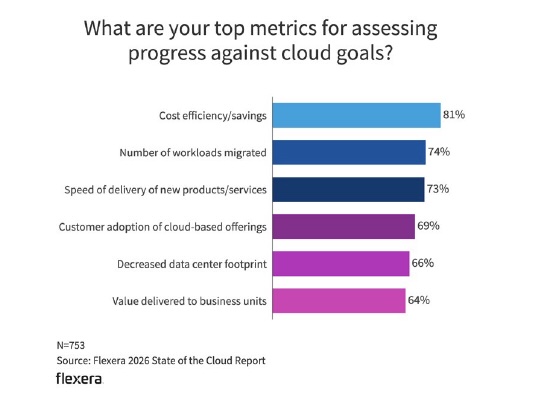
While value delivered to business units is not the top-ranked metric in Flexera's 2026 report, success against many higher-ranked metrics depends on a value-optimized cloud environment. Migrating workloads, accelerating product and service delivery, and increasing customer adoption all require cloud environments that are stable, secure, performant, and aligned with business outcomes.
In the value era, the strongest cloud management best practices are not simply the lowest-cost strategies. They are the strategies that make cloud easier to manage, justify, and connect to business growth.
Build a Cloud Management Strategy That Works Harder for Your Business
The strongest cloud management strategy connects every infrastructure decision to a business outcome. Cost efficiency matters—but it is one input among many, not the end goal.
The organizations gaining the most from their cloud investments manage cloud through a complete lens: application performance, security, reliability, team productivity, and financial control working together. This is what distinguishes a cloud computing value proposition that leadership can act on from one that only satisfies a finance team's quarterly review.
Americaneagle.com helps organizations build and operate cloud environments through exactly this kind of value-driven, application-centric approach. Whether you're looking to reduce waste, improve performance, or gain clearer visibility into what your cloud spend is actually delivering, Americaneagle.com's hosting and managed cloud services can help.
Contact us for more information on our hosting and managed cloud services.
FAQs About Cloud Cost Management Strategies
What is the difference between cloud cost management and cloud value management?
Cloud cost management focuses on reducing and controlling cloud spending—right-sizing resources, eliminating waste, and managing commitments. Cloud value management is broader: it connects cloud investments to business outcomes like application performance, delivery speed, customer adoption, and team productivity. The two are complementary, but value management treats cost as one input into a larger equation rather than the primary measure of cloud success.
Why are organizations moving away from cost-only cloud management strategies?
According to Flexera's 2026 State of the Cloud Report, cost efficiency as a primary cloud success metric dropped 6 percentage points year over year, while value delivered to business units rose 12 points. Cost-only cloud management strategies can slow product releases, constrain teams, and create operational risk—all of which carry real business costs that don't appear on the cloud bill.
What is an application-centric cloud management approach?
An application-centric cloud management approach connects infrastructure decisions to the specific applications they support—including performance requirements, security controls, user experience expectations, and business outcomes. Rather than managing cloud at the resource level (CPU, storage, compute), application-centric management ties every operational decision to the workload it enables and the value that workload delivers to the business.
How can organizations measure the business value of their cloud investments?
Effective measurement starts with unit economics—understanding cost per service, transaction, or customer. Beyond that, cloud business value metrics include application uptime and latency, release velocity, security incident frequency, and developer productivity. Linking these metrics to customer adoption and revenue impact helps cloud and engineering teams communicate cloud ROI in terms that resonate with business leadership.
What results can organizations expect from a value-driven cloud management strategy?
AEMCS clients have achieved cloud spend reductions of 15–30% while simultaneously improving application performance, reliability, security, and team productivity. The combination of financial control and operational improvement is what distinguishes a value-driven cloud management strategy from a cost-reduction exercise—and it is why organizations that adopt this approach tend to sustain improvements over time rather than cycling through one-time optimization efforts.
How does Americaneagle.com approach cloud management differently?
Americaneagle Managed Cloud Services uses a continuous, application-centric operating model that applies senior-engineer expertise to optimize software and infrastructure together. Rather than defaulting to more expensive cloud provider resources, the approach connects cloud spend to the applications, workflows, databases, APIs, and user experiences those resources support—delivering both cost efficiency and performance improvements across the full stack.
What is the difference between FinOps and traditional cloud cost management?
FinOps (Financial Operations) is a more mature cloud cost management discipline that aligns engineering, finance, and business teams around shared cloud spending decisions. Traditional cloud cost management tends to focus narrowly on infrastructure-level savings, whereas FinOps introduces accountability through unit economics, chargeback models, and shared ownership of cloud ROI across departments.
When should an organization consider outsourcing cloud management to a managed service provider?
Outsourcing cloud management is most beneficial when an organization lacking in-house expertise to optimize across the full cloud stack, is spending significant time on reactive infrastructure issues rather than product delivery, or needs better visibility into how cloud spend maps to business outcomes. Managed cloud providers like Americaneagle.com are better suited for organizations that want proactive, senior-level cloud expertise without the overhead of building and retaining that capability internally.