


Happy birthday, cloud computing!
Twenty years ago this month, Amazon’s Jeff Bezos stood before an MIT audience at the Emerging Technologies Conference and told a packed auditorium that companies were wasting their resources on developing undifferentiated muck.
Ouch.
That "muck" was physical IT infrastructure; the virtually identical, woefully underutilized stacks of servers, storage, and firewalls every business was building out to do business in the 21st century. His position was that this was a massive drain on resources that did absolutely nothing to drive innovation.
His fix? Rent the internet-connected “world-class muck” that Amazon developed over 11 years to sell books and Xboxes and innovate on top of it, competing on ideas rather than the ability to buy and manage hardware.
A few weeks later, BusinessWeek ran a cover story titled “Jeff Bezos’ Risky Bet,” suggesting the idea was a distraction and that Bezos should mind the store. Twenty years later, Amazon is worth roughly 200 times what it was that day, and the cloud has become the foundation for two decades of growth at hundreds of thousands of companies.

The Muck Moved Up the Stack
Driven by the ability to build best-of-breed “super apps” with features from each provider, redundancy, compliance, and, increasingly, AI, 73% of organizations now run hybrid or multicloud environments.
But that complexity has a price. Managing cloud spend is now the top challenge for 85% of cloud decision-makers, outranking security for the fourth straight year. Cloud waste remains another top concern, especially because optimizations in this area typically fall outside the realm of expertise for FinOps personnel. Opportunities to reduce costs here are often buried in the application layer in the form of unoptimized applications, inefficient database and API configurations, and infrastructure sized for the wrong workload.
Just as Amazon turned its core strength into the answer for infrastructure muck, Americaneagle Managed Cloud Services (AEMCS) is turning Americaneagle.com’s core strength into the answer for today’s software and application muck.
Provisioning Hardware as a Blunt Instrument
For many companies, the cloud management playbook is also 20 years old. When an application hits a bottleneck or a traffic spike, the standard operating procedure is to throw more CPU, memory, and storage at it to avoid downtime. The bill goes up. The underlying problem remains. The cycle repeats.
But this is not just a process problem. It is a people problem, too. Thirty percent of cloud decision-makers name skills gaps among their top three obstacles. Only 7% of technology hiring managers say they have the talent they need to complete priority projects, and 71% say skills shortages have already delayed projects in the past year.
Solving Muck with What We Do Best
Just as Amazon turned its core strength into the answer for infrastructure muck, Americaneagle Managed Cloud Services (AEMCS) is turning Americaneagle.com’s core strength into the answer for today’s software and application muck.
Americaneagle.com has built and hosted websites and cloud applications in its own data centers for three decades. As the foundational components of those applications moved from on-premises hardware to the cloud, our company’s expertise moved with them. That meant learning to manage environments mixing on-prem and cloud components well before hybrid and multicloud became commonplace.
Thousands of complex applications later, that bare-metal-to-code-to-cloud experience has produced a set of management practices built to get the most out of the hardware a client is already paying for. When performance falls short, instead of reaching for the infrastructure hammer, our experienced team looks past the symptom for the actual cause.
Filling the Gap
Short of going out and hiring scarce talent, technology leaders are forced to choose from the available managed cloud choices, all of which have blind spots:
- The large systems integrators are built for infrastructure scale.
- The WebOps providers are often walled platforms.
- Legacy MSPs tend to monitor server uptime rather than application health.
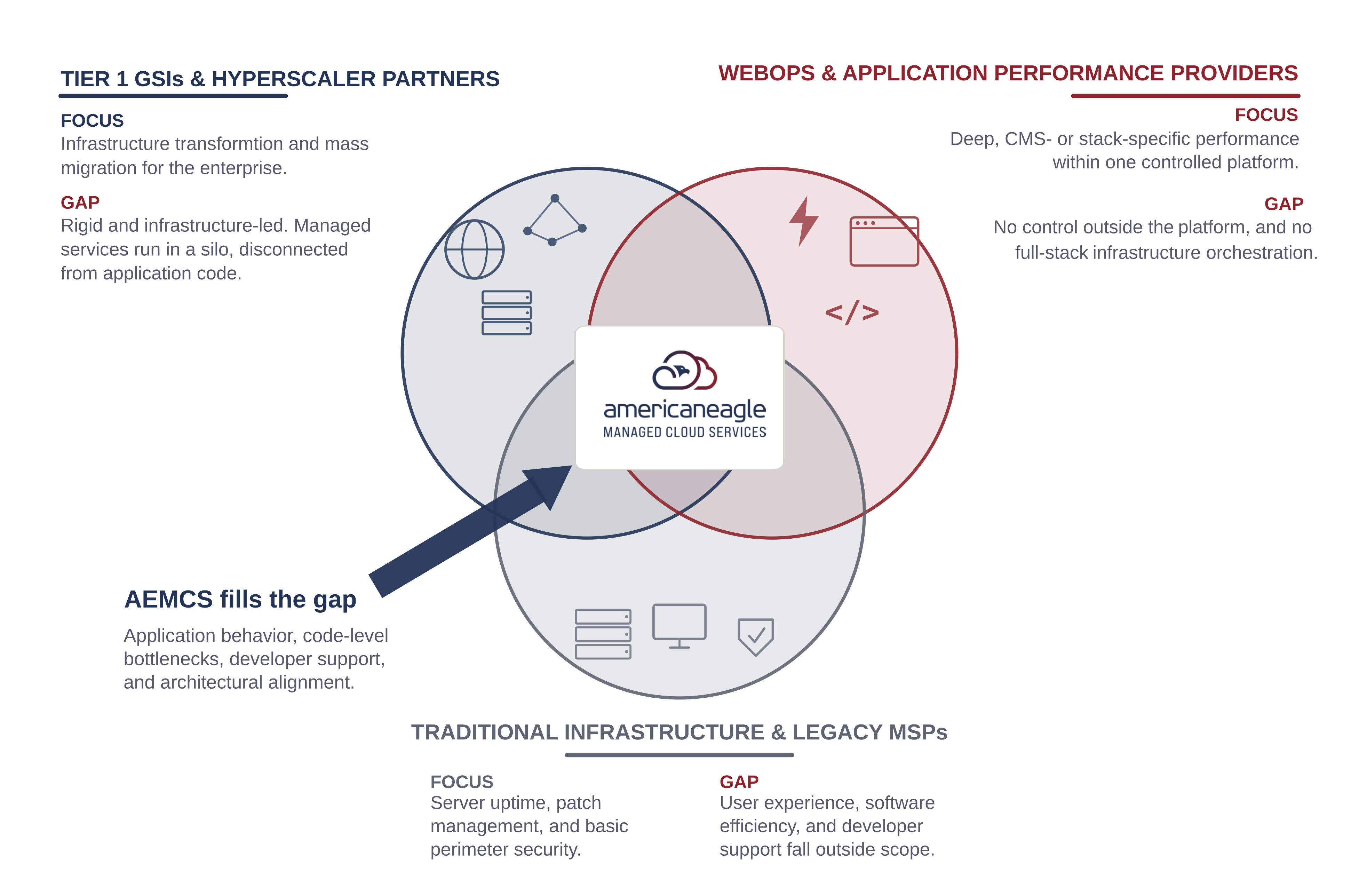
AEMCS fills the managed services capability gap needed to address today’s cloud cost and complexity.
AEMCS sits between them, pairing the multicloud and bare-metal insights with the software-level performance tuning of a WebOps specialist. The result is a new playbook for today’s cloud environments, providing a full-stack, application-centric approach that closes the legacy gaps.
That matters because of how engineering teams are evaluated. Most are incentivized toward feature velocity and system stability, not resource efficiency. Datadog’s research found that 83% of container spend goes to idle resources. Finding that waste is one thing. Safely removing it is another. Our engineers have the application-layer expertise to right-size the environment and tune CDN caches, instead of expensive, blunt force infrastructure spend, without putting stability at risk.
Fire Prevention vs. Firefighting
For one recent client, a 50% jump in monthly cloud spend and a costly renewal on the horizon pushed senior executives to mandate a fix. AEMCS found over-provisioned compute, inefficient storage tiering, and bloated backups worth nearly $23,000 a month. Rather than pulling engineers off core projects, our team right-sized the VMs and improved cluster efficiency directly. The client kept the savings, kept their roadmap, and walked into renewal negotiations from a position of strength.
In this case, the mandate to resolve the issue came from an executive team who understood the problem, and that resolving it required outside expertise. This enabled AEMCS to get the access needed to assess and fix the environment.
That's not always the case.
Research on company outsourcing shows that bringing in outside expertise activates a fear of job loss. That fear is understandable, but it protects the wrong thing. Waste and instability don't stay quiet forever, and when they surface, it's rarely the internal team that raises the alarm first. It's leadership, asking why nobody did. By then, the damage is done.
AEMCS doesn't ask a team to step aside. We work as an extension of the team already in place, closing gaps instead of replacing people.
Our complimentary, engineering-led assessment is the lowest-risk way to answer that question before someone else has to. Sign up here or contact us to start a conversation about your cloud or hosting needs.